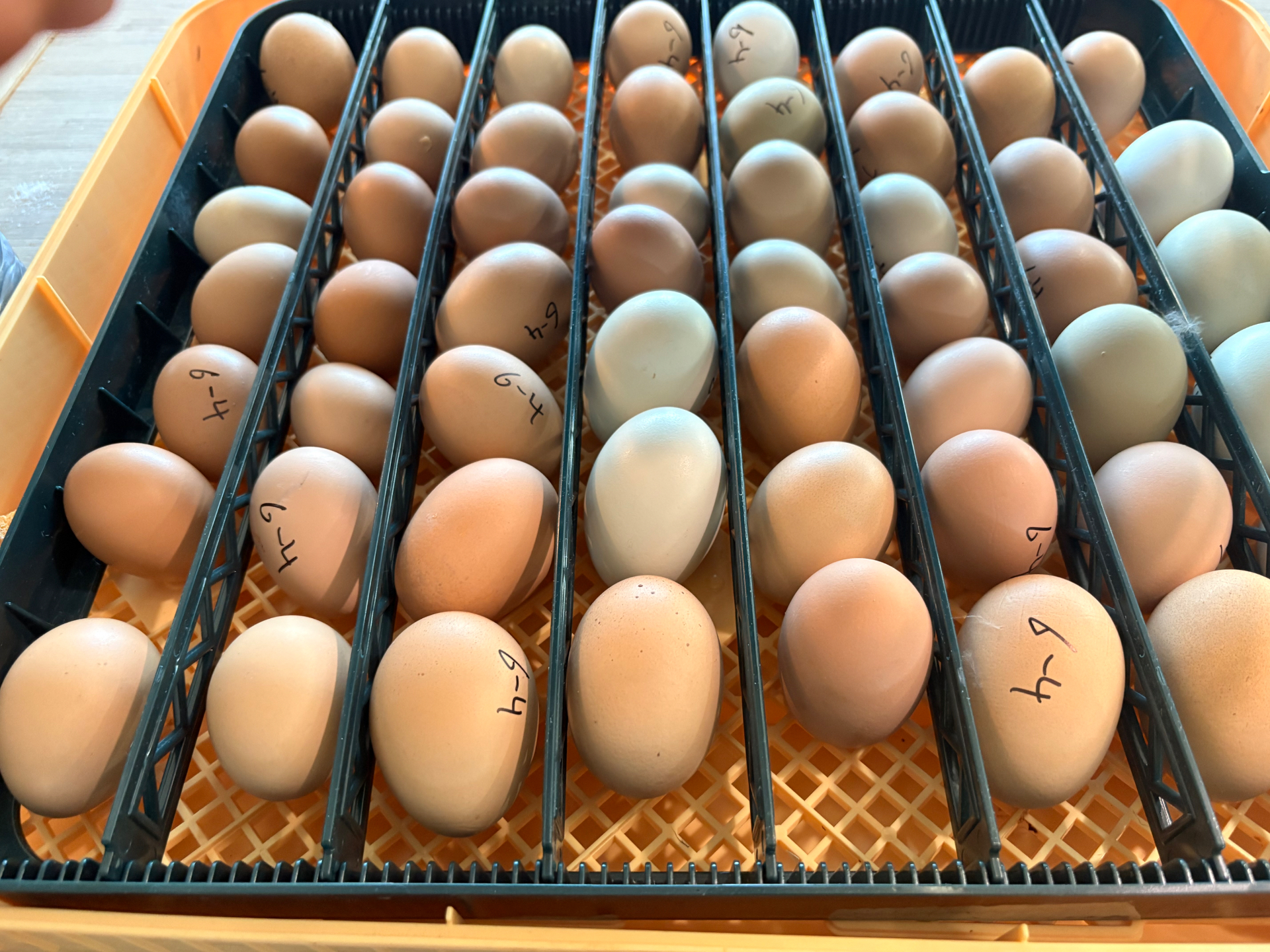
A full incubator tray of brown, cream, and blue-green chicken eggs, each marked '6-4' for the set date.
Mixed-flock hatch — Day 14 in the incubator
Set on June 4. A full tray of brown, cream, and blue-green eggs, all from our own hens.
Read this to your kid first
"We set a full tray of eggs on June 4 — brown, cream, and blue-green, all from our own hens. Today is Day 14 of 21. The chicks are fully formed in miniature. We're going to learn why the shell colors are different, and then we'll each make a guess about how many will hatch and what color shells will be most common."
Field notes
On June 4 we filled the incubator with eggs from our own flock — brown ones from the Marans and Australorps, cream from the Brahmas, and the blue-green ones from the Olive Eggers and Easter Eggers. Every egg is marked '6-4' in pencil so we know the set date.
Today is Day 14. The thermostat reads 99.5°F. The auto-turner tips the eggs every hour so the yolk doesn't stick to one side of the shell. The chicks are fully formed in miniature now — they spend the next week mostly growing and absorbing the yolk.
We are guessing how many of each shell color will hatch, and what the chicks will look like. Egg color is set by the hen; chick color comes from both parents.
The learning
What's actually happening
Words to know
- Candling
- Shining a bright light through an egg to see the chick growing inside.
- Embryo
- A baby animal in its earliest stage of growth.
- Air cell
- A small pocket of air at the fat end of the egg. It grows bigger as the chick gets bigger.
- Lockdown
- The last 3 days of incubation. We stop turning the eggs and raise the humidity so the chick can hatch.
Your turn
Make your guesses
Enroll a kid to save guesses.
Count the eggs you can see in the photo. How many of those do you think will hatch into healthy chicks?
Hint: A good hatch rate for home-laid eggs is around 75–80%.
Which shell color will be MOST common in the hatch?
Why do you think the incubator has to TURN the eggs every hour for the first 18 days?
Hint: Think about what would happen if you sat in the same position for three weeks straight.